
Drifting: The Art of Controlled Chaos
Drifting is more than just a motorsport; it’s a thrilling combination of precision, style, and chaos that has captivated car enthusiasts worldwide. Originally born in the mountains of Japan, drifting has evolved into a global phenomenon, from underground street races to professional competitions. With its blend of technical skill and showmanship, drifting is one of the most visually striking and exciting forms of motorsport today. But what exactly is drifting, and how did it go from a niche Japanese subculture to a worldwide spectacle?
What Is Drifting?
At its core, drifting involves intentionally losing traction in the rear wheels of a car while maintaining control and navigating a corner in a high-speed, sideways manner. Unlike traditional racing, where the goal is to maintain the tightest line possible around a track, drifting celebrates controlled slides, where the car moves sideways through turns, often with the tires squealing and a cloud of smoke billowing behind. The art of drifting is all about balancing speed, angle, and control to make the car perform in the most stylish and controlled way possible.
The Origins of Drifting
Drifting as we know it today traces its origins to the mountainous roads of Japan in the late 1970s and early 1980s. Japanese street racers, especially those involved in illegal mountain races (called touge racing), began experimenting with ways to take tight corners at high speeds. In these twisty, narrow mountain roads, staying on the racing line was crucial, and the only way to do so effectively was by deliberately sliding the car through sharp corners.
One of the key figures in drifting’s early days was Keiichi Tsuchiya, a Japanese racer known as the “Drift King.” Tsuchiya became famous for his skill at driving sideways, often outmaneuvering opponents by maintaining control while drifting through corners. His expertise and influence helped bring drifting from the streets to the track, and his participation in video games, anime, and media further solidified his status as one of the sport’s most iconic figures.
Drifting as a Motorsport
While drifting initially gained popularity on the streets, it didn’t take long for it to evolve into a professional motorsport. By the late 1990s and early 2000s, organized drifting competitions began to spring up in Japan, and soon after, the sport gained international recognition.
In 2003, the Formula Drift championship was launched in the United States, and this move helped cement drifting’s place in mainstream motorsports. Today, Formula Drift is one of the most popular drifting competitions worldwide, attracting top-tier drivers and thousands of fans.
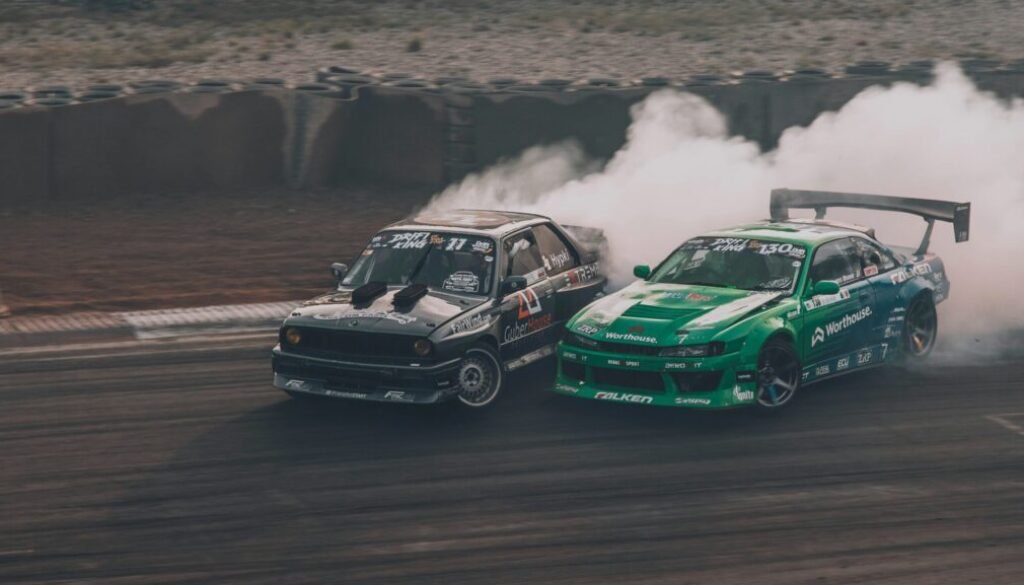
Professional drifting events involve cars performing tandem runs, where two drivers go head-to-head, with one attempting to “chase” the other. The lead driver is responsible for setting the pace and the angles of the drift, while the chasing driver must match the lead driver’s drift as closely as possible, maintaining their own speed and control.
Judges score the runs based on factors like speed, angle, and precision. The more dramatic and controlled the slide, the higher the score. The entire spectacle is enhanced by the roaring engines, tire smoke, and squealing rubber, making drifting one of the most visually captivating motorsports.
The Culture and Appeal of Drifting
Drifting has become more than just a competitive sport—it’s a global culture. The thrill of watching cars slide sideways at breakneck speeds is what draws fans in, but the culture surrounding drifting is what keeps them coming back. The tight-knit community of car enthusiasts, mechanics, and fans all contribute to the energy that surrounds the sport. Social media, YouTube, and car meets have further amplified the popularity of drifting, giving fans direct access to their favorite drivers and teams.
Drifting has also led to a unique style of car modification, where enthusiasts build their cars specifically for the sport. This means custom suspension systems, wide tires, and massive turbochargers are common in drifting cars. The focus is not only on performance but also on creating a car that can showcase style and precision while drifting.
Conclusion
Drifting, born from the mountain roads of Japan, has transformed into a global motorsport that combines skill, style, and speed. Its evolution from illegal street racing to organized competition shows the dedication of those who have brought the sport to where it is today. Whether you’re a driver or a spectator, drifting continues to captivate with its unique blend of controlled chaos and performance art. It’s not just about getting from point A to point B—it’s about doing it in the most thrilling, sideways way possible.
Photo by Ralfs Blumbergs on Unsplash